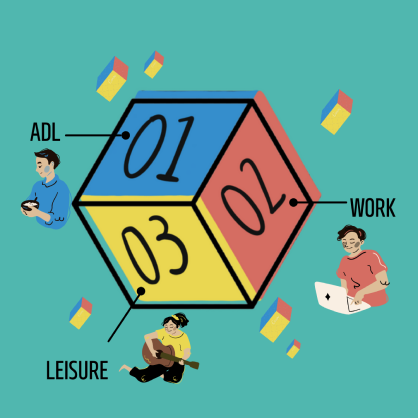


Occupational therapy is a client-centred health profession concerned with promoting health and well being through occupation. The primary goal of occupational therapy is to enable people to participate in the activities of everyday life. Occupational therapists achieve this outcome by working with people and communities to enhance their ability to engage in the occupations they want to, need to, or are expected to do, or by modifying the occupation or the environment to better support their occupational engagement. (WFOT 2012)
Occupation is the purposeful use of time and energy in self-care, work and leisure activities. Occupational therapy is the design and use of therapeutic activities to increase independent function in self-care, work, and leisure; to enhance development; and to prevent disability. It may include adaptation of task or environment to achieve maximum independence and to enhance quality of life.
Occupational Therapy in Hong Kong goes back only 39 years. It was in 1949 that the first handicraft instructor (rattan worker) was employed to work in the Mental Hospital at High Street on Hong Kong Island…
In 1955, Wanchai Polyclinic was opened providing occupational therapy for hemiplegic patients. However, this unit closed down after only a short time owing to a lack of staff…
The Sixties were busy years with their share of ups and downs. In 1960, there were four Occupational Therapists and 18 Occupational Therapy Assistants…
The Spastics Association of Hong Kong employed their first occupational therapist in 1974. Now they have 24 therapists in their 15 service units…
The early seventies were lean years for occupational therapists in the Medical and Health Department. Rehabilitation centres were being opened such as David Trench, Hong Kong Psychiatric Centre, Kowloon Hospital West Wing but there were no staff to man them…
Membership Year
A membership year will subsist from 1st May to 30th April of the subsequent year.
Membership Tenures and Subscription Fee
1 Year
3 Year
5 Years
$390
$1,050
$1,650
$350
$940
$1,480
1 Year
Free
Free
1 academic year
4 academic years
$100
$200
$100
$200
1 Year
$390
$390
Membership Benefits
***For new member registration, 5 working days for verification of application information and supporting documents are required. New member will receive a confirmation email with login details for your new account upon successful membership subscription. Member’s benefits will be effective when membership subscription is confirmed. Please ensure your personal information is sufficiently provided (FULL Name in English and Chinese, HKID e.g. A123xxx(x)) for our smooth vetting process.
2120 9266
Mon – Fri, 0900 – 1700
Copyright @ 2024, Hong Kong Occupational Therapy Assocication. All right reserved.
Occupational Therapy in Hong Kong goes back only 39 years. It was in 1949 that the first handicraft instructor (rattan worker) was employed to work in the Mental Hospital at High Street on Hong Kong Island. This marked the beginning of occupational therapy in Hong Kong. It is interesting to note that well before this period (between 1941 and 1946), it is recorded that in the United States the number of registered occupational therapists almost doubled, going from 1,144 to 2,265.
Through the enthusiasm of a physiotherapist called Miss Wallace Turner, a committee was formed in 1950 comprising herself, the Acting Director of Medical and Health Services, Dr. Uttley, and the Medical Secretary, Mr. Brickford to discuss the issue of occupational therapy. This committee controlled a sum of HK$900.00, donated largely from the Jockey Club for setting up occupational therapy in Hong Kong, and to supervise a group of voluntary helpers and the paid rattan worker.
A corner of the old physiotherapy department on the ground floor of Queen Mary Hospital (a general hospital) was set aside for the use of the voluntary helpers. Under the guidance of Miss Turner, they provided diversional therapy for tuberculosis and orthopaedic patients in Queen Mary Hospital and Lai Chi Kok Hospital (a psycho-geriatric hospital in Kowloon), and also for the mental patients at the Mental Hospital in High Street.
In January of 1953, the committee employed an occupational therapist, Miss J. Hopkins on a part-time basis with an honorarium of HK500.00 a month. This arrangement was to stand until the Hong Kong Government made up its mind whether to create a permanent post or not.
In February, Miss Hopkins submitted a lengthy report on why occupational therapy was needed in Hong Kong. It may be the results of this report that a full-time post was created, although only tentatively for a year to prove its worth.
Obviously it was proven worthwhile, as in March 1954, two permanent posts were created.
It is interesting to note that, initially, patients were hesitated about doing occupational therapy but, as they came to understand that the crafts were given only if of therapeutic value to orthopaedic patients, they became increasingly responsive and their numbers increased as the year progressed. Soon the staff were unable to cope with the number of patients. At this time, there was still no department except the corner of the Physiotherapy Department in Queen Mary Hospital. At Lai Chi Kok Hospital, two small rooms were made available and a small sheltered workshop was set up for patients who could not return to open employment because of their disabilities. These patients made waste paper baskets and mended dustbins and were apparently paid for their work.
In 1955, Wanchai Polyclinic was opened providing occupational therapy for hemiplegic patients. However, this unit closed down after only a short time owing to a lack of staff.
At this time, there was only one Occupational Therapist and three Occupational Therapy Assistant.
In 1956, Queen Mary Hospital at last acquired an Occupational Therapy Department which was 9.3 metres x 4.7 metres. Evidently it was an uncomfortable department with a huge hot chimney running up through the middle of it. No air conditioning of course – none of the departments had air conditioning in those days. Outside the unit, only 2 metres away, they were busy preparing the foundations for the new Operating Theatre block – drilling through solid rock from 9 a.m. to 5 p.m. – the noise and dust were unbearable.
1956 was not a good year as there was only one part-time Occupational Therapist for most of the year. But progress was seen during 1957 and 1958. There were departments at Queen Mary Hospital, Lai Chi Kok Hospital, High Street and Wanchai Polyclinic.
In November 1957, Miss Kathleen Wright arrived from England to work in Hong Kong; she was later to become our first Superintendent Occupational Therapist. She was married to a doctor in Port Health a few years later and known to us as Mrs. Kathleen Smart.
Miss Peggy Martin, who succeeded Mrs. Smart as the next Superintendent Occupational Therapist, arrived in 1958 to work at Lai Chi Kok Hospital. She was a very good crafts woman and got the long-term paraplegic patients on to rugmaking and other very saleable articles such as macrame work. There was no industrial work yet, apart from making brooms for the government.
In 1959, Castle Peak Hospital, a psychiatric hospital, was opened with two Occupational Therapy Assistants. In-patients from the Mental Hospital in High Street were moved there. This was the year that the World Federation of Occupational Therapists joined the World Health Organization and established a roster of expert advisors to work in countries trying to develop their own occupational therapy programmes.
The Sixties were busy years with their share of ups and downs.
In 1960, there were four Occupational Therapists and 18 Occupational Therapy Assistants.
1961 saw the creation of the Superintendent Occupational Therapist post which was filled by Mrs. Kathleen Smart.
By 1962, there were nine Occupational Therapists working in the government and Kowloon Rehabilitation Centre was opened in 1963. So far, most of the therapists were from the U.K., but in December 1964, the first Chinese therapist was recruited. She was not a local but a Malaysian Chinese, who unfortunately stayed only a few short years. It is also interesting to note that the foreign therapists had to learn Cantonese on one of the government courses in order to enable them to communicate with patients in the settings.
Mrs. Elsie White, who succeeded Miss Martin as the next Superintendent Occupational Therapist, arrived in 1965. At this time there were seven Occupational Therapists working in six hospitals i.e. Queen Mary Hospital, Hong Kong Psychiatric Centre, Kowloon Rehabilitation Centre, Queen Elizabeth Hospital, Castle Peak Hospital and Lai Chi Kok Hospital.
In 1967, Yaumatei Psychiatric Centre was opened. There was obviously a need for local staff, so in 1967, (the year of the beginning of the Cultural Revolution), the first three male local Chinese students were sent to Australia under Government scholarships to train as occupational therapists. One of them, K.M. Hui, is our present Superintendent Occupational Therapist and the other two are Senior Occupational Therapists in the government.
Another three male Chinese students were sent to Australia in 1968 under government scholarship to train. Meanwhile, the first senior post was created at Castle Peak Hospital – the start of a professional structure. Interestingly, Wanchai Polyclinic reopened a tiny department catering for upper limb orthopaedic patients and cerebral palsy children. This was the only department for outpatients on Hong Kong Island.
It was also during the sixties that occupational therapy was being developed in the private sub-vented sector with units in the John F. Kennedy Centre (for cerebral palsy), Duchess of Kent Children’s Orthopaedic Hospital and Haven of Hope Hospital. Same years later, Kwong Wah Hospital and Caritas Medical Centre also set up occupational therapy units. The Spastics Association of Hong Kong employed their first occupational therapist in 1974. Now they have 24 therapists in their 15 service units.
The Sixties were busy years with their share of ups and downs.
In 1960, there were four Occupational Therapists and 18 Occupational Therapy Assistants.
1961 saw the creation of the Superintendent Occupational Therapist post which was filled by Mrs. Kathleen Smart.
By 1962, there were nine Occupational Therapists working in the government and Kowloon Rehabilitation Centre was opened in 1963. So far, most of the therapists were from the U.K., but in December 1964, the first Chinese therapist was recruited. She was not a local but a Malaysian Chinese, who unfortunately stayed only a few short years. It is also interesting to note that the foreign therapists had to learn Cantonese on one of the government courses in order to enable them to communicate with patients in the settings.
Mrs. Elsie White, who succeeded Miss Martin as the next Superintendent Occupational Therapist, arrived in 1965. At this time there were seven Occupational Therapists working in six hospitals i.e. Queen Mary Hospital, Hong Kong Psychiatric Centre, Kowloon Rehabilitation Centre, Queen Elizabeth Hospital, Castle Peak Hospital and Lai Chi Kok Hospital.
In 1967, Yaumatei Psychiatric Centre was opened. There was obviously a need for local staff, so in 1967, (the year of the beginning of the Cultural Revolution), the first three male local Chinese students were sent to Australia under Government scholarships to train as occupational therapists. One of them, K.M. Hui, is our present Superintendent Occupational Therapist and the other two are Senior Occupational Therapists in the government.
Another three male Chinese students were sent to Australia in 1968 under government scholarship to train. Meanwhile, the first senior post was created at Castle Peak Hospital – the start of a professional structure. Interestingly, Wanchai Polyclinic reopened a tiny department catering for upper limb orthopaedic patients and cerebral palsy children. This was the only department for outpatients on Hong Kong Island.
It was also during the sixties that occupational therapy was being developed in the private sub-vented sector with units in the John F. Kennedy Centre (for cerebral palsy), Duchess of Kent Children’s Orthopaedic Hospital and Haven of Hope Hospital. Same years later, Kwong Wah Hospital and Caritas Medical Centre also set up occupational therapy units. The Spastics Association of Hong Kong employed their first occupational therapist in 1974. Now they have 24 therapists in their 15 service units.
The early seventies were lean years for occupational therapists in the Medical and Health Department. Rehabilitation centres were being opened such as David Trench, Hong Kong Psychiatric Centre, Kowloon Hospital West Wing but there were no staff to man them.
In order to cope with the clinical training of occupational therapy students, three Clinical Teaching Units were set up in 1980 in three hospitals. Each Unit was run by a Clinical Unit Supervisor who supervised a group of students on clinical placement in addition to taking a clinical caseload.
The year 1981 saw the formation of the Occupational Therapy Board consisting of ten members, six of whom were occupational therapists. It is part of the Council on Professions Supplementary to Medicine, the government body solely responsible for the implementation of registration for the paramedical professions.
Another major event for occupational therapists occurred in 1981, when a new rank of Occupational Therapist II was introduced, thereby increasing the management possibilities. By July there were 38 of these new posts, 29 Occupational Therapist I posts and 12 Senior posts – indeed a very large increase in staff.
The course at the Polytechnic was recognized by WFOT, (World Federation of Occupational Therapists), backdated to 1978 when the course first commenced. This was greatly rejoiced by all concerned, because now private agencies who had been unwilling to employ therapists from overseas because of the logistics involved, were very happy to employed locally trained occupational therapists. These private sector employers included the areas of mental handicap and specials schools.
In the early eighties, the Medical and Health Department was planning a massive expansion programme with development extending to Tuen Mun and Taipo in the New Territories, and East Kowloon and Shau Kei Wan on Hong Kong Island. In order to meet this expansion of services, the Hong Kong Polytechnic increased its student intake to 60 in 1982 and 80 in 1983. Similarly, increases were made in other paramedical fields. However, owing to unforeseen circumstances, many of these hospital expansion plans were delayed, resulting in the present ironical situation of having graduates but insufficient jobs for them. This has been the situation over the past two years and it looks no different for the 1988 graduates.
Presently, there are over 250 occupational therapists working in Hong Kong’s 81 centres; 20 of these are in the New Territories, 20 on Hong Kong Island and 41 in Kowloon. As well as the many traditional areas, the fields of practice in occupational therapy include:
Emerging fields of practice are seen in services for the aged, domiciliary occupational therapy, work in the community e.g. outreach centres for the physically and mentally handicapped, and in sheltered workshops. Occupational therapy has certainly come a long way since its humble beginnings in 1949. In Hong Kong, with its present population of 5.6 million people is still thriving and developing in all areas, including its health services. With further development, Hong Kong will be able to boast a health service comparable to other centres worldwide.